Hong Kong International Airport Makes Bid As Hub for Asia
Its Completion
Since Hong Kong’s return to the People’s Republic of China, one year has passed leaving various political and economic topics outstanding.
Hong Kong, with its over 6.5 million population living within the 1,000 km2 area, was enjoying economic growth during the last decade. To facilitate such economic growth towards the 21st Century, an overall strategic infrastructure provisioning scheme was planned by the previous Hong Kong Government with the long term view that all the related projects be brought to completion during the ten years leading up to 1997.
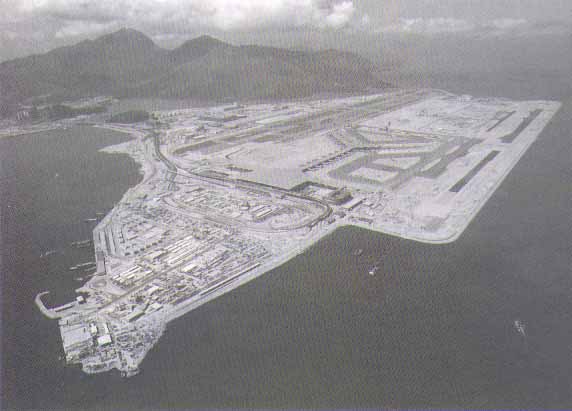
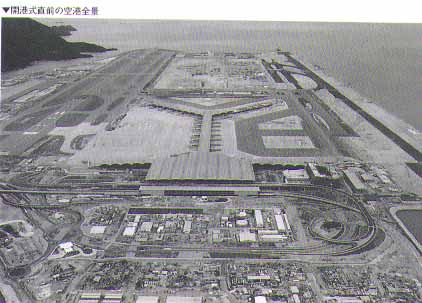
Though the scheme comprised of many various projects, the major project group was construction of the new airport and its associated works. On 2nd July 1998, the opening ceremony of the new airport was held and President Jiang Zemin of the People’s Republic of China announced its official opening. This was followed by opening for business on 6th July symbolizing Hong Kong’s first stride towards further prosperity in the new Century. The new airport is named HONG KONG INTERNATIONAL AIRPORT, which was constructed on a 1,248 hectare off-shore man-made island formed by moving approx. 300 million cubic metres of soil/rock.
The new airport locates off the northwest coast of Lantau, the largest island in Hong Kong, and approximately 25 kilometers from the center of Hong Kong. The main accesses to the new airport are by the Airport Railway and the new highways, taking passengers from the center of Hong Kong to the new airport in approx. 30 minutes. During initial operation, a single runway of 3,800 metres long, 60 metres wide is used and when a second runway and extension of passenger terminal is completed by the end of 1998, the airport will be capable of handling 35 million passengers and 3 million tonnes of cargo per year. Upon its final completion in 2040 ( as indicated in the Master Plan of the Provisional Airport Authority - Hong Kong ), the airport will become one of the busiest airports in the world with an annual capacity of 87 million passengers (departure and arrival) and 9 million tonnes of air cargo.
Having been originally scheduled to open in April 1997, the construction programme was affected by political disputes regarding funding between the United Kingdom and the People’s Republic of China resulting in delay of programme by about one year and four months. However, the new airport will be a key element for Hong Kong’s future prosperity and is expected to be the most important hub for economic development in the South-east Asia region.
Simple Guide to the New Airport
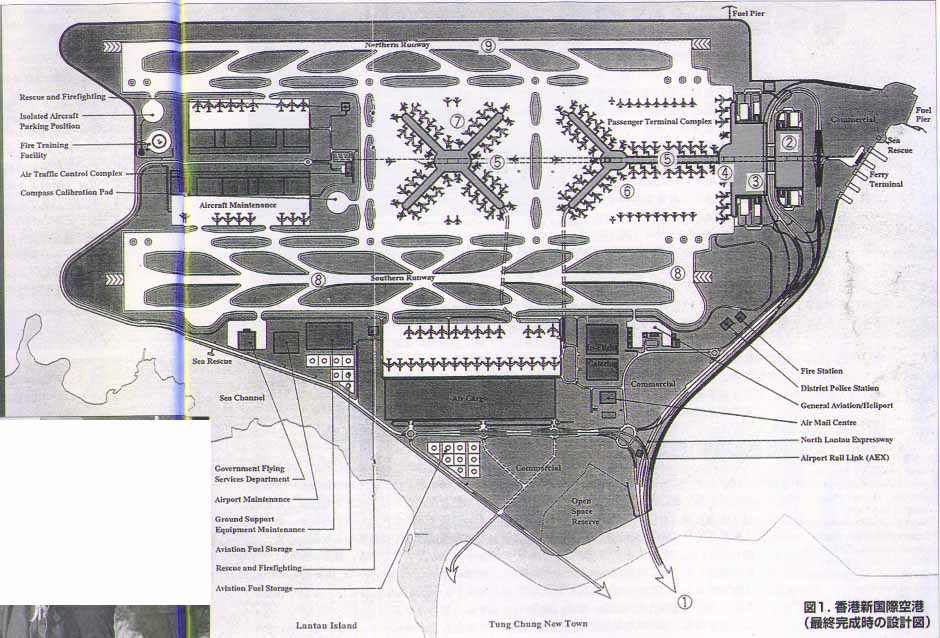
Drawing - No.1 shows the airport at its final completion and shows a simplified passenger flow to and in the airport.
Figure (1) is the entrance to the airport for the Airport Railway as taken by the Airport
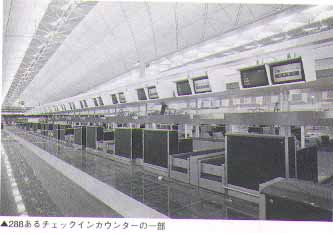
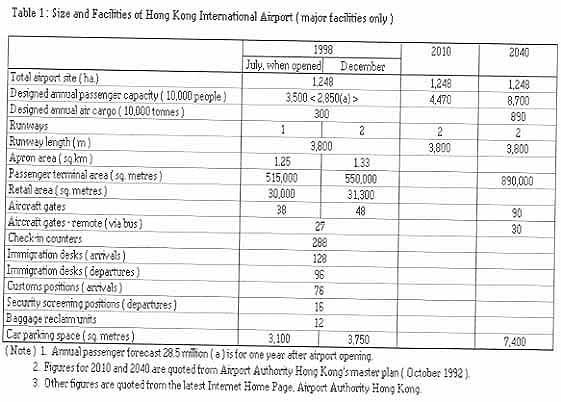
Express. Fig. (2) is the Ground Transportation Centre, the main access point for road and rail transport where bridges link the rail station to the Terminal Building at Fig. (3). After checking in at one of the 288 counters, then passing immigration process and security screening point, passengers are led to the aircraft gates by the Automatic People Mover, an internal shuttle train ( Fig. (4), (5) ). Currently 38 frontal gates and 27 remote gates are in service. In its final completion a total of 120 aircraft gates will be provided. Fig. (6) shows the overall arrangement of the aircraft gates in 1998 and Fig.(7) is the future satellite extension. Fig. (8) is the Southern Runway now under operation and Fig.(9) is the Northern Runway which is scheduled to be completed by the end of 1998. Table - 1 shows the facilities at the new airport.
Provision of Infrastructure
As previously mentioned, the Hong Kong Government followed an overall strategic infrastructure provisioning scheme with the long term view that all the related projects be completed during the ten years leading up to 1997. The Government carried out the basic planning, investigation and feasibility study for this overall strategic infrastructure provisioning scheme during the 1970’s.
The scheme is, in principle, classified as ;
● Port and Airport Development Strategy ( abbreviated as PADS )
● Redevelopment of Urban Areas
● Transport Policy in Hong Kong
● Strategic Sewage Disposal Scheme
● Private Investments associated with the above.
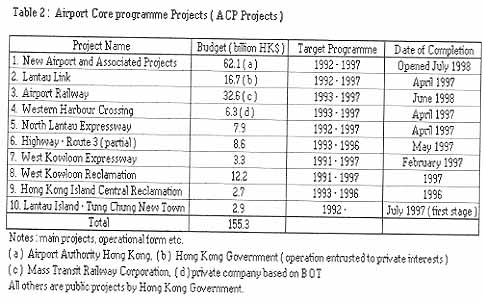
Within the above, the Port and Airport Development Strategy (PADS) is the main part of the overall infrastructure provisioning scheme. The total project sum of PADS, which was modified in April 1993, reached HK$163.7 billion (US$21.2 billion). PADS and other basic schemes contain various construction projects, which are collectively called Airport Core Programme projects ( ACP ). Construction of the new airport was the main objective of ACP but it included other major projects. These include 34 kilometres of expressways and tunnels ; a high-speed rail link that connects the airport with centre of Hong Kong ; the world’s longest road-rail suspension bridge ; a third cross-harbour tunnel between Hong Kong and Kowloon Peninsula, and a new town development. The total estimated cost of the entire ACP is HK$ 155.3 billion ( US$ 20 billion ) in Money of the Day terms. Within the ten projects of ACP, seven of the projects were funded and carried out by the Government as direct capital works projects. The Airport Authority Hong Kong built the new airport and the Mass Transit Railway Corporation provided the railway that serves the airport. Both are statutory bodies wholly owned by the Government. The Western Harbour Crossing, the new cross-harbour road tunnel, was built by the private sector under a 30-year "build, operate and transfer" ( BOT ) franchise. Table - 2 shows ACP Projects.
Characteristics of ACP Projects
ACP Projects present some unusual characteristics. One is the high international participation and another is the large size of the individual construction contracts.
The Hong Kong Government welcomed international participation in the ACP, and applied a "level playing field" approach in tendering procedures and the award of contracts. As well as local Hong Kong companies, a significant number of international companies from a wide range of countries were awarded construction or consultancy contracts. By the end of April 1997, 176 major contracts were awarded by the Government, the Airport Authority, the Mass Transit Railway Corporation and the private sector.
The contract awards reflect the international nature of the ACP. Japan gained the largest share with 26% (by value) followed by: Hong Kong (24%), UK (16%), China (8%), the Netherlands (5%), France (5%), Belgium (3%), New Zealand (3%), Spain (2%), Australia (2%), the United States (2%), Germany (2%) and others (including Italy, South Africa, Austria, Norway, Portugal and Denmark) ( approx. 1%).
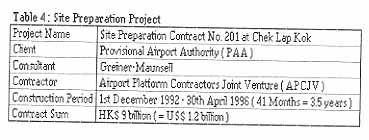
Concerning the contract prices, the largest single contract awarded was HK$ 10.1 billion ( US$ 1.29 billion ) for the Passenger Terminal Building in 1995, the second largest was HK$ 9.04 billion ( US$ 1.15 billion ) for Site Preparation Contract in 1992 for forming the 1,248 hectare off-shore island.
Site Preparation for New Airport
General
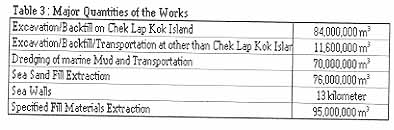
The new airport was constructed on an off-shore man-made island of 1,248-hectares, which is approximately the same size as the Kowloon Peninsula. About three quarters of the site area was made up of a massive reclamation from the sea, with the rest formed from the excavation of the small original islands of Chek Lap Kok and Lam Chau. More than 300 million cubic metres of material such as soil and rock, at roughly 10 tonnes a second, were moved during the site preparation works. Some 36,000 tonnes of explosives and 120,000 kilolitres of fuel oil were needed to complete the works within the contract period. The works were scheduled from 1st December 1992 to 30th April 1996 (41 months), however, the programme was shortened by 3 months. Table - 3 shows the major quantities of the work.
Project Characteristics
The Site Preparation Contract are summarized in Table - 4.
Main characteristics of the project were :-
● extremely tight construction schedule for an extensive amount of works; and
● utilization of the world’s largest fleet of heavy earth moving plant and marine dredging equipment.
Construction of the works was carried out by a multi-national consortium, named Airport Platform Contractors Joint Venture ( APCJV ). The joint venture was formed by multi-national civil and marine works contractors from six different countries. Nishimatsu Construction Co., Ltd of Japan was the leading member of APCJV with a contractual management organization as shown in Table - 6.
The joint venture consisted of contractors and sub-contractors, from Japan, United Kingdom, United States, Netherlands, Belgium, China, Australia , and Hong Kong.
Project Execution and Objectives
Accomplishment of the moving of a total of the 300 million cubic metres of material within three and half years needed, not only a significant number of heavy plant, but also the effective planning, programming and efficient management of the works to ensure perfect co-ordination between all the parties involved.
The client, the Provisional Airport Authority (PAA) carried out the basic planning co-ordination and supervision of the land development operation. A Differential Global Positioning System (DGPS) using satellite signals was applied to marine works, whilst for land works, computerization of aerial picture data taken by special photographic techniques was used.
The contract required an extremely tight construction schedule and specified the quality of the finished work. To meet such time scale, the planning objectives for the land works were:
● Max. Excavation Rate 4,000,000 m3/month
● Max. Explosives Rate ( production ) 120 ton/day
● Max. Rock Blasting Rate 50,000 m3/blasting
The planning objectives for the marine works were:
● Max. Dredging Rate 2,500,000 m3/month
● Max. Reclamation Rate 2,500,000 m3/month
Remarks
As one of the largest civil engineering construction projects in the world, the construction of the site formation work for the Hong Kong International Airport, was satisfactorily carried out by a completely multi-national group of contractors under the very close co-operation of the client, PAA, and other relevant parties.
Environmental Considerations
The former Kai Tak Airport was notorious for the adverse environmental impacts on its vicinity. The new airport was planned with paramount attention paid to environmental protection measures. All aspects were studied : noise, water, air, fishery etc. Every effort was taken to protect the environment, including the transfer of certain frogs native only to Chek Lap Kok Island but which found equally comfortable circumstances on another island.
Redevelopment of Former Kai Tak Airport Land
On 5th July 1998, the Kai Tak Airport closed to end its 73 years history.
The land occupied by the Kai Tak Airport ( approx. 334 hectare ) will be re-developed as part of PADS projects in near future ( 1999 to 2010 ). It is expected to play a leading role in the further economic growth of Hong Kong.
☆ ☆ ☆ ☆ ☆ ☆ ☆ ☆ ☆
On completion of this unique airport, it should be recognized that Hong Kong is standing at the threshold of the 21st Century. It will ensure the prosperity of Hong Kong and will undertake a key role, not only of South Asia, but also of the world.
This article is provided, basically using published and/or well-known information, as a brief report on the planning and construction of the land formation works for the Hong Kong International Airport at Chek Lap Kok.
Main information and data are quoted from ;
1. New Airport Project Co-ordination Office -- Internet Home Page
2. Airport Authority - Hong Kong -- Internet Home Page
3. New Airport Master Plan, October 1992 ( Provisional Airport Authority )
4. Construction of New Hong Kong International Airport ( Brochure issued by Nishimatsu Construction Co., Ltd Hong Kong Branch )
☆ ☆ ☆ ☆ ☆ ☆ ☆ ☆ ☆